 ADHD
ADHDBuild a brain that lives outside your head.
A scroll-through class. By the bottom of this page you'll know a complete system for getting things done with AI, even on your foggiest day.

Your brain was never meant to hold all of this.
The emails. The call you owe Person A. The idea from the shower. The thing you promised. Every open loop is a crumpled paper stuffed into the backpack.
Working memory is a small table.
Not a broken table. A small one. Every new thing that lands shoves an old thing off the edge. ADHD brains feel this hardest, but every brain has the same small table.
So you try to hold more. It doesn't work.
Trying harder to remember is stuffing more papers into a full backpack. The papers aren't the problem. The storage is.
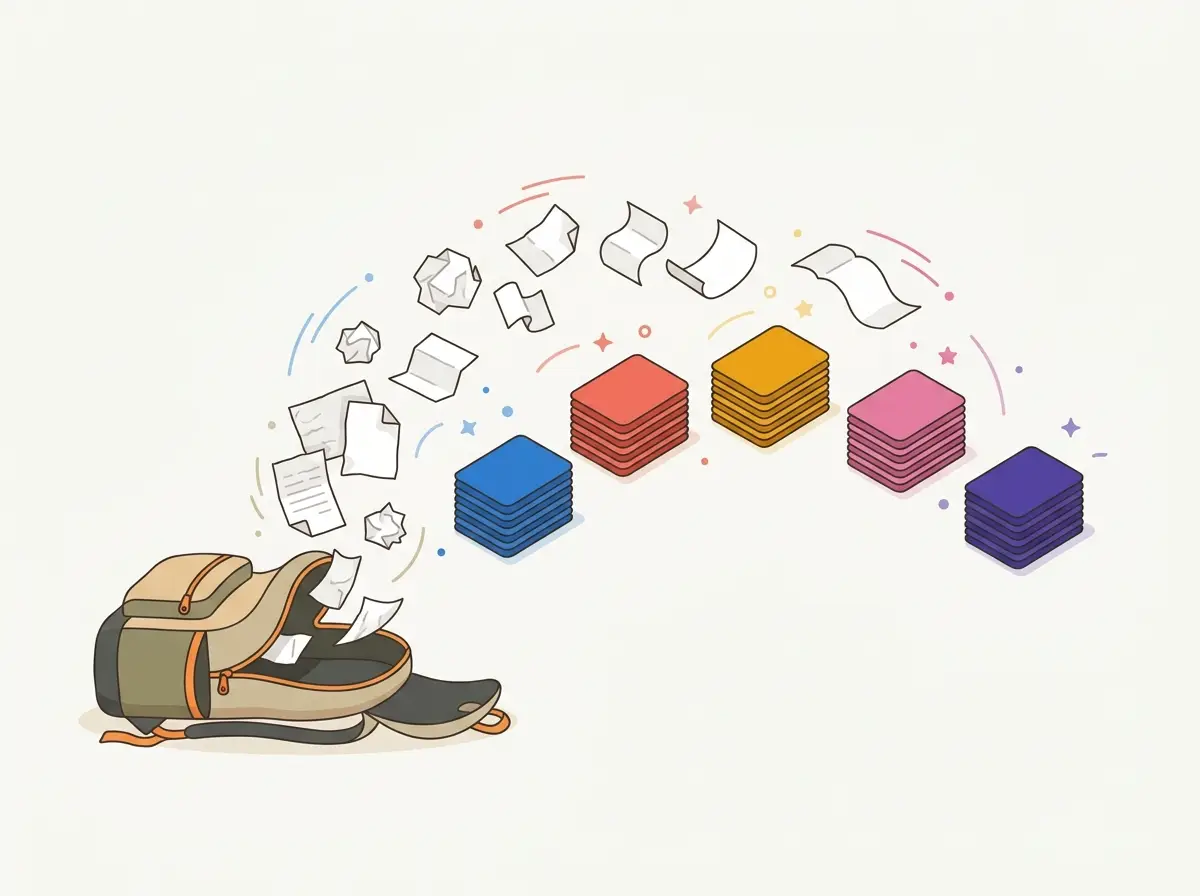
The fix isn't holding more. It's putting thoughts outside your head.
People have always done this. Julia Cameron's Artist's Way turned it into a morning ritual. Tiago Forte's Second Brain turned it into a note system. The 2026 twist: for the first time, the outside brain talks back.
Did: sorted the mail pile
Stopped: at the tax folder
Next tap: open the first envelope
Note: it's smaller than it looks
Dump the backpack by talking.
Out loud, messy, unedited, into a free AI app. You do not organize while you dump. The rule while yapping: the AI just listens until you say DONE.
The AI flattens the mess into five piles.
Tasks, Worries, Ideas, Feelings, Questions. Five piles, short bullets, no big plan. Seeing the mess sorted is the moment most people exhale.
Pick up ONE paper. A tiny one.
One physical action, two to ten minutes. If the AI hands you a mountain, you say one word: SMALLER. It has to shrink the step. Try it on the boulder.
Save your game before you walk away.
Four lines: what I did, where I stopped, my next tiny tap, one note to future me. Interruptions stop costing you the whole level. This is the step everyone skips.
"If AI doesn't make your next step smaller, it's not helping."
That's the whole philosophy. Wall of text? Say SHORTER. Big plan? Say SMALLER. The AI works for you, not the other way around.
Wispr Flow claims about 4x faster than typing.
✅ You promised the draft by Friday
✅ Person A sends the numbers
💡 Idea: turn the intro into a video
↑ ⠀⠀⠀⠀ ↓
🧠 ← 📚 ←
Stop typing. Talk everywhere.
Your phone's built-in dictation is free and already good. Tools like Wispr Flow go further: you talk into any app and messy speech comes out as clean writing, with a personal dictionary that learns your words over time. Yapping stops being a special activity. It becomes how you write.
Meetings become yaps you don't have to capture.
Tools like Granola sit on your computer during Zoom, Meet, or Teams calls, no bot joining, and hand you the notes and action items afterward. Its free tier keeps capturing your meetings — you can view the most recent 30 days without paying. You stay present. The papers file themselves.
The brain improves the longer you feed it.
This is the part nobody tells beginners: the system compounds. Your SNAP cards become a diary the AI can read back. Your dictation tool learns your names and slang. Your saved maps show patterns you couldn't see alone. Ten minutes a week reviewing your cards, and next month's brain has far more context to work with than this month's.
Tool details captured July 2026 from vendor pages; features and prices change. Start with the free tiers. The method matters more than the tools.
Build your personal brain in about 2 hours
Four pieces. Any free AI app plus any notes app you already have. Tap each piece as you set it up.
1 · One dump spot
Pick the ONE place every yap goes: a chat with your AI app, or a voice memo you paste in. Ten scattered systems equal zero systems.
2 · The master prompt, saved
Paste the master prompt below into your AI once, and save it somewhere you can copy it from forever. It sets the rules: listen while I yap, sort into five piles, one tiny action, short answers.
3 · One card habit
Index cards or a notes page: every work session ends with a SNAP card. Four lines. Your future self always has a save file to load.
4 · The two safety rules
Fake names only (Person A, Company B, Project X), nothing you wouldn't write on a postcard, no medical, legal, or money details. And remember the AI can be wrong.
Then make it stick: the 7-day program
Like morning pages, but the notebook answers. One small practice a day. Day 4 is the day the system proves itself.
Yap + get your map
One messy brain dump, five tidy piles. That's the whole day.
Tap one pebble
One action from your own map, under 10 minutes.
Make a SNAP card
End the day with a save file. Four lines.
Restart from your card
Load yesterday's save. Feel how cheap restarting just became.
Body double sprint
10 minutes working alongside your AI or a friend. (People with ADHD swear by body doubling; it's not clinically proven.)
Shrink something scary
Take one big dread task and say SMALLER until it fits in 10 minutes.
Build your own master prompt
Rewrite the prompt in your words. Now the system is yours.