 ADHD
ADHDThe ADHD Rabbit Hole: Why You Dive, and How to Climb Out With the Thread Still in Your Hand
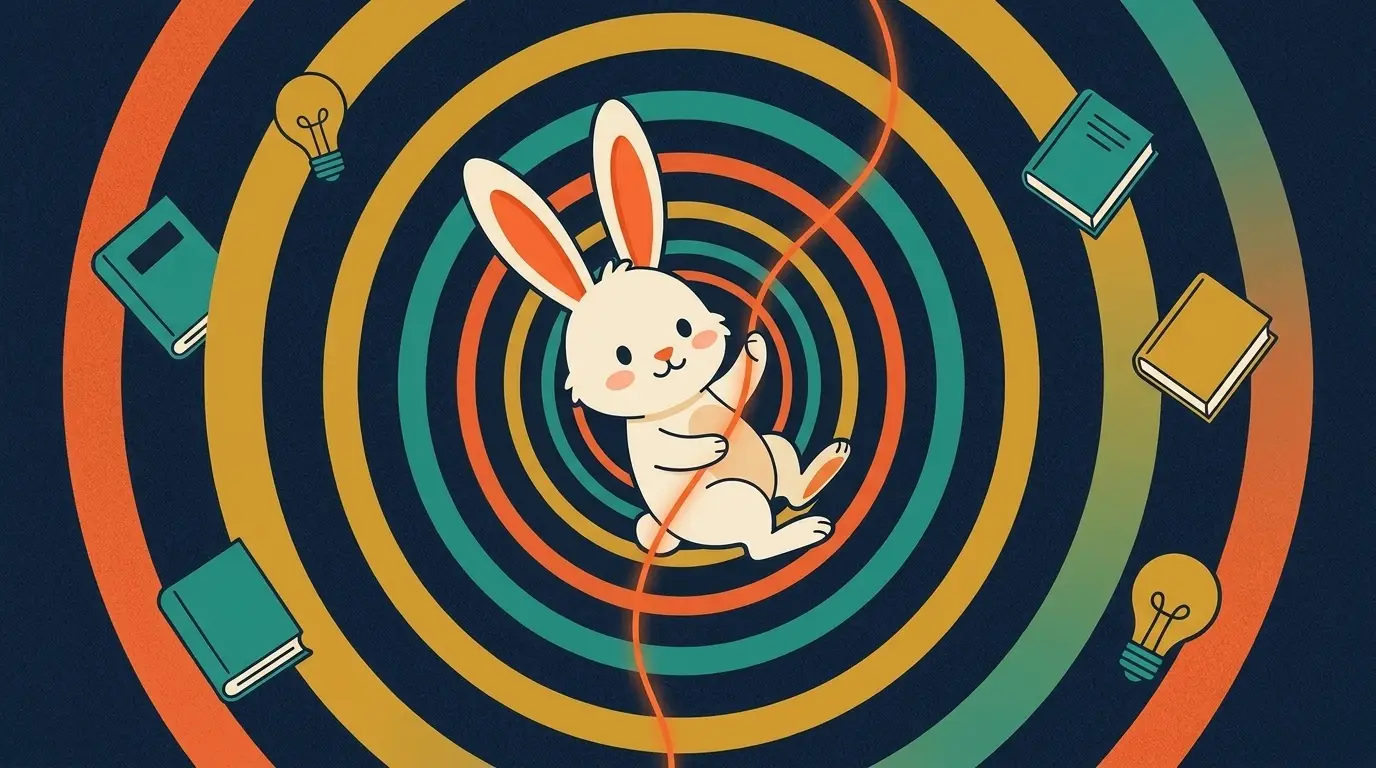
It starts with one tab. You're writing an email, you need one fact, and forty minutes later you're reading about a shipwreck. You know this place. We call it the ADHD rabbit hole, and if you have an ADHD brain, you didn't fall in because you're careless. You fell in because the hole is shaped exactly like your wiring.
Why your brain dives
ADHD attention runs on interest, not importance. A 2018 brain-imaging study in the journal Brain suggests ADHD brains weight novelty about twice as heavily as other brains, and that chasing the novelty predicted worse task performance, not better. The new thing sparkles. The task you were doing has known, distant rewards. The shipwreck is right there and it's shiny.
There's a second engine underneath, and it's the one almost nobody names. A lot of ADHD adults describe it this way: your brain grips the interesting thought because it's afraid of losing it. ADHD working memory is a small table. You've lost a thousand good ideas off that table, and your brain remembers the grief. So when something fascinating appears, part of you dives immediately because diving feels like the only way to keep it.
You don't chase the rabbit because you're weak. You chase it because you don't trust it to still be there later.
That reframe changes the whole fight. The goal was never to want things less. The goal is to make the interesting thing safe to leave.
Why "just focus" fails, and blocking apps mostly do too
White-knuckle focus asks an interest-driven brain to run on importance, which is the one fuel it doesn't burn well. Blocker apps wall off the internet but do nothing about the gripped thought, which keeps tapping your shoulder from inside. Both approaches treat curiosity as the enemy. For an ADHD brain, curiosity is the engine. Kill it and you lose the good hyperfocus along with the bad spirals.
And one honest caution from the research: the same novelty circuit that pulls you down rabbit holes is the one AI chat interfaces are built to feed. A 2025 paper at CHI (a major computing-research conference) ties this exact mechanism to chatbot addiction-pattern design — a directional finding we haven't independently re-verified. Endless prompting can become the rabbit hole. The fence below works on that one too.
The two-move fix: park it, save your place
The way out is two tiny moves, and neither one costs you your train of thought.
Move one: park the shiny thing. The second something interesting hijacks you, capture it in one line somewhere it cannot get lost. An Ideas pile, a notes app, or tell your AI: park this in my Ideas pile, one line, then point me back to what I was doing. The moment the thought is safe outside your head, the grip releases. You didn't suppress the idea. You promised it a future, and your brain accepts that deal.
Move two: save your place before any dive you choose to take. Some rabbit holes deserve ten minutes. That's allowed. The trick is making a SNAP card first: what I was doing, where I stopped, my next tiny tap. Now the dive has a floor. When the timer ends, the card reads you right back into your original thread, and returning costs nothing. Interruptions were never the problem. Losing your place was.
The fork at the top of every rabbit hole
What happens to the shiny thought decides everything
Keeping the flow you actually want
Here's the part that matters for anyone who loves their deep-dive brain: not every long focus session is a rabbit hole. The research distinction is useful here — flow is voluntary and tied to the task in front of you (it's the working definition we teach on our hyperfocus page too). The spiral is involuntary and drifts away from it. You can tell them apart with one question, asked about twenty minutes in: is this making my next step smaller? A real dive into your actual project passes that test. Reading about the shipwreck does not.
And curiosity still gets fed, on purpose. Give the parked ideas a container: twenty minutes tonight, after the tap is done, with the Ideas pile open. A scheduled rabbit hole is a hobby. An unscheduled one is a workday leak. Same curiosity, different plumbing.
The prompt kit for the rabbit hole
All of these live on the mindmap under The ADHD rabbit hole, ready to copy:
- Park it: "New idea just hijacked me: [the idea]. Park it in my Ideas pile in one line, then point me back to the ONE thing I was doing. Don't discuss the new idea."
- SNAP before you dive: "I want to chase something for 10 minutes. First make my SNAP card: what I was doing, where I stopped, my next tiny tap. Then start a 10-minute timer. When I say BACK, read me the card."
- The brake, for AI rabbit holes: "I've been talking to you a while without doing anything. Stop giving me new ideas. Pick one action from what we already have, give it to me, then don't reply until I say DONE."
None of this is clinical treatment, and no study shows any AI tool improves ADHD outcomes. This is a method for keeping your thread while your curiosity stays alive. It works because it stops asking your brain to be a different brain.

Take the whole system with you
The free 43-page ebook: the brain science in plain words, the four steps, the master prompt, and your first seven days.
Prefer it live? Doug teaches this in libraries and meetups — book a 90-minute class →